
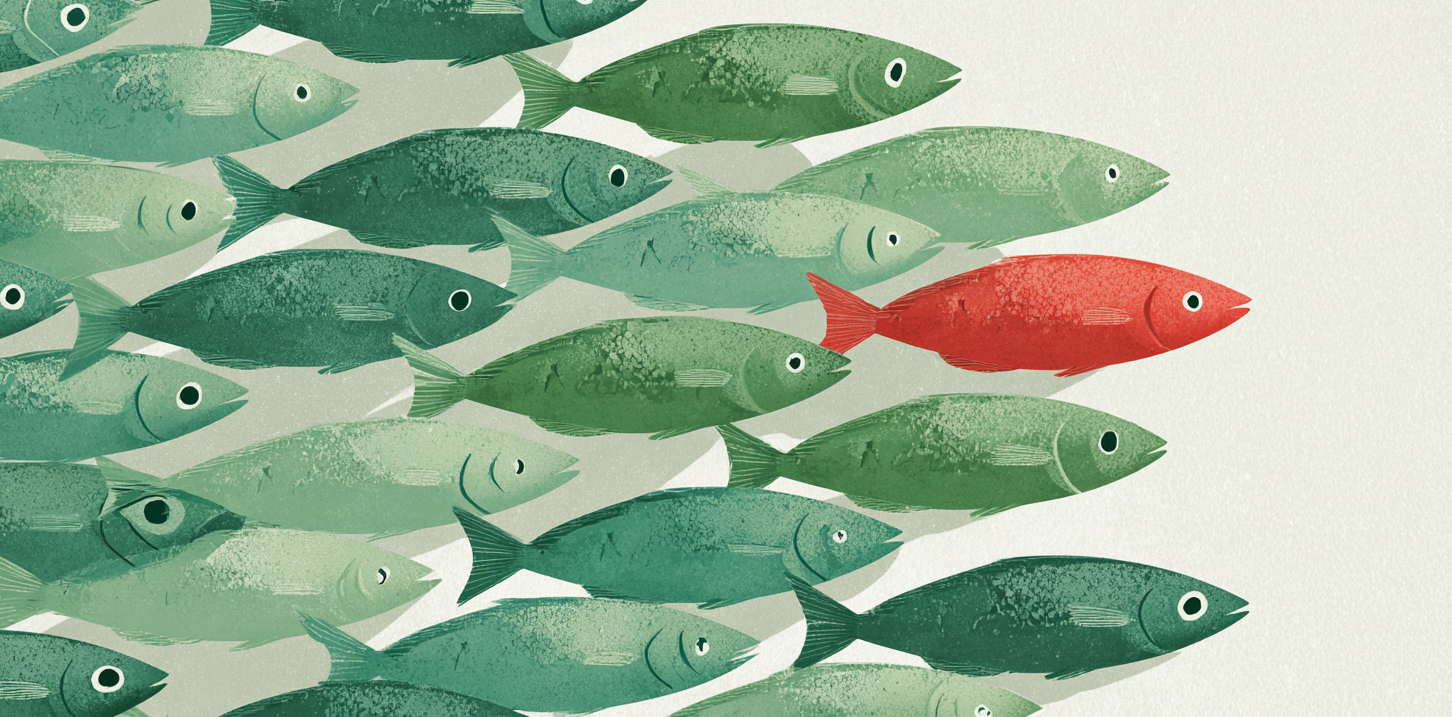

It takes roughly 440 wild-caught fish to raise a single farmed salmon.
To feed carnivorous farmed fish, large quantities of wild fish are caught, ground into fishmeal and oil, and fed back into the aquaculture system. By the time a single salmon reaches your plate, they may have already consumed more fish than you’ll eat in a year.
So why has fish farming been marketed as the sustainable future of food? For decades, that’s exactly what we’ve been told. Wild fish stocks are dwindling, and scientists have been sounding the alarm on overfishing since the 19th century. Aquaculture looks like a promising solution—but few consumers realize that vast numbers of wild fish are harvested simply to feed the predatory species being farmed. Fisheries targeting small fish used for feed account for roughly one-third of the global catch each year, with 70% of their haul going to aquaculture. About 90% of these fish are suitable for human consumption, yet are processed into feed.
And the industry is growing fast. Fish farms now supply just over half of the world’s seafood, a rise fueled by government subsidies, industry investment, and the international promotion of aquaculture as the answer to overfishing. Yet the environmental costs—pollution from concentrated waste, disease outbreaks, escaped farmed fish, and continued pressure on the wild populations harvested for feed—have drawn far less attention. The scale and intensity of these operations have led some researchers and advocates to call them the “factory farms of the sea.”
Aquaculture wasn’t always like this.
From ponds to pens
Fish farming is ancient. Around 6,000 years ago, Australia’s Gunditjmara people engineered channels and traps to farm short-finned eels. Thousands of years later, Chinese farmers domesticated carp in artificial ponds. Ancient Egyptians raised tilapia, Romans farmed oysters, and the Japanese cultivated carp and koi.
But modern aquaculture bears little resemblance to those origins. Traditional methods relied on natural waterways and native species, leaving surrounding ecosystems largely undisturbed. Industrial aquaculture is driven by yield. Fish farms pack as many animals as possible into their pens. More fish, more profit.
Aquaculture now accounts for the majority of global seafood production, but its rise is relatively recent. Before it became industrialized at scale, seafood production was driven primarily by wild-capture fisheries. Beginning in the 1890s, those fisheries expanded rapidly, propelled by motorized vessels, cold storage, and global markets. Subsidies and government policy fueled decades of fleet growth, and the strategy paid off. Seafood became cheaper, more abundant, and more globally accessible than ever before.
Then, in 1989, global marine fish catches peaked—and stalled. Many fisheries had been pushed beyond their limits. Unlike factory farming, whose harms can be tucked away in remote feedlots, overfishing unfolded in public view: the fish were running out. That visibility may help explain why collapsing fisheries drew sustained public attention, even as the environmental harms of land-based animal agriculture remained largely hidden.
Enter sustainable seafood
Alarm over depleted oceans fueled the rise of sustainable seafood marketing. In 1997, conservation groups and NGOs founded the Marine Stewardship Council (MSC) in response to collapsing fisheries. By 2000, the blue MSC label began appearing on seafood products, promising fish from sustainable sources.
Seven years later, Happy Feet captured audiences with the story of Mumble, a lovable penguin whose actions led to an overfishing ban. For the film’s 2007 DVD release, Seafood Watch—a sustainable seafood advisory program—partnered with Warner Bros. to distribute roughly nine million pocket guides alongside a short video titled Where Did All the Fish Go?
“In the last fifty years, we have had more impact on the wildlife in the sea than during all preceding history,” the video warns. It urges consumers to seek sustainable certifications while avoiding the question of whether current seafood demand is itself unsustainable.
If we’re eating fish faster than populations can replenish themselves, the solution seems obvious: eat less fish. Yet reducing consumption is not always central to sustainability discussions. Consumers have grown accustomed to constant abundance, with diverse seafood options available year-round and few obvious limits on consumption. Aquaculture promises a way to maintain that demand while claiming to protect ocean ecosystems. Whether it can do both, however, is another question.
The sustainable seafood paradox
Aquaculture is pitched as the answer to overfishing—a way to keep meeting global demand without further depleting the oceans. Yet today, roughly a third of the world’s assessed fish populations are so overexploited that they can no longer recover on their own, threatening not just marine ecosystems but the coastal communities and industries that depend on them.
The seafood industry’s marketing tells a far more optimistic story than the evidence supports.
Across dozens of aquaculture company and trade association websites, the messaging is remarkably uniform: fish farming is framed as a way to relieve pressure on depleted wild stocks, produce protein efficiently, and use fewer resources than conventional livestock. Sustainability claims are widespread, alongside assurances about protecting marine ecosystems and coastal communities. Many are unsupported by clear evidence.
Take Cooke Aquaculture, one of the world’s largest salmon farming companies. The company markets itself as “better for the environment, better for our fish, better for our customers, and better for our communities,” citing endorsements from third-party seafood certifiers. Behind the branding, the company has faced lawsuits and regulatory scrutiny over pollution from its salmon farms, including alleged Clean Water Act violations involving the discharge of fish waste, uneaten feed, and carcasses into surrounding waters. In a separate case later dismissed by a federal judge, Animal Outlook sued Cooke over alleged misleading sustainability claims and welfare abuses, citing undercover footage that appeared to show cruel handling, inhumane slaughter, and unsanitary conditions.
With no federal welfare regulations specifically protecting farmed fish, facilities face few restrictions on how fish are confined, handled, and slaughtered. Intensive conditions and pollution concerns can coexist with industry messaging that frames aquaculture companies as stewards of ocean health. Cooke is not an isolated example.
Inside the net pens
The industry frequently points to aquaculture’s lower carbon footprint compared with land-based animal agriculture as evidence of its sustainability. But lower emissions alone do not automatically make an industry sustainable, and emissions are not low across the board. Emissions are significantly higher for high-trophic species such as shrimp and salmon, which are typically exported to wealthier countries.
Lower carbon emissions do not eliminate aquaculture’s other environmental costs. Chief among them are the effects of intensive confinement. Packing large numbers of animals into confined spaces produces two recurring problems: excess waste and disease.
Fish waste consists of fecal matter and uneaten feed. In large quantities, it releases excess nitrogen and phosphorus into surrounding waters, fueling algal blooms, degrading water quality, and harming nearby marine life. A single industrial fish farm can generate up to one million pounds of waste a year—equivalent to the annual sewage output of a city of 65,000 people. Much flows directly into surrounding waters.
The effects are felt inside the pens as well. Farmed fish are typically raised in high-density conditions that contribute to stress, injury, and illness—conditions comparable to other forms of intensive animal agriculture. Crowded pens facilitate the spread of diseases and parasites, especially sea lice, crustaceans that feed on fish tissue and cause open wounds and infections. Researchers say these infestations can spill over to nearby wild fish populations.
To control disease, farmed fish may be dunked in hydrogen peroxide baths, fed medicated feed, or run through pressurized water jets that strip sea lice mechanically. Some operations are also experimenting with vaccines and specialized feeds designed to improve resistance to infection. The interventions have prompted concerns about antibiotic resistance, environmental contamination, and chemical residues in seafood. Their long-term effects remain unclear.
Escapes pose another risk. Selectively bred or genetically modified fish that escape from net pens can compete with wild fish for resources and interbreed with them, despite being bred for traits such as rapid growth that may be poorly suited to survival in the wild. Scientists worry that the resulting genetic mixing could erode the fitness and resilience of wild populations over time, placing additional pressure on already strained stocks.
Despite concerns about pollution, disease, and escapes, the industry continues to market many aquaculture products as sustainable, often on the strength of certifications that critics say are too narrow to capture the industry’s broader ecological costs.
What “sustainable” certifications leave out
Consumers are increasingly willing to pay a premium for products marketed as environmentally friendly. The industry has responded by aggressively marketing farmed seafood as sustainable. Opponents call it greenwashing, enabled by standards they view as weak or unevenly enforced. In 2024, Best Aquaculture Practices (BAP), one of the industry’s largest certifiers, came under scrutiny after reports alleged the program had approved farms that used banned chemicals and tolerated sea lice infestations severe enough to threaten nearby wild salmon.
More than 70 organizations signed an open letter accusing BAP of misleading consumers, citing environmental damage, illegal practices, and threats to endangered species at BAP-certified farms around the world. The controversy drew renewed scrutiny to the role sustainability certifications play in marketing farmed seafood.
Seafood fraud is also widespread. Lower-cost species are routinely sold as higher-value fish, and farmed salmon are sometimes passed off as wild-caught. A 2015 Oceana investigation found that 43% of salmon samples tested in US restaurants and grocery stores during the off-season were mislabeled. Most were farmed Atlantic salmon sold as wild-caught. This deception is not limited to species: sustainability and ethical sourcing claims are frequently overstated, helping justify higher prices for products marketed as responsibly sourced.
The industry has also been accused of “bluewashing,” overstating its commitment to environmental stewardship and social responsibility. Aquaculture companies frequently promote job creation and local economic growth. But in some coastal regions, the expansion of large-scale fish farming has displaced small-scale fishing communities and restricted access to traditional fishing grounds.
Aquaculture is also pitched as a solution to global food insecurity, on the grounds that it can produce large quantities of protein cheaply and consistently. In practice, much of the output is exported to wealthier countries and sold in premium retail and restaurant markets. A UN report found that some forms of aquaculture may deepen food insecurity in poorer regions, estimating that roughly half a million tons of fish pulled from West African waters each year—enough to feed 33 million people—are converted into fishmeal to raise farmed fish later sold in European and Asian markets.
The efficiency problem
You may have heard the slogan: “Eat a farmed fish, save a wild fish.” From a welfare standpoint, the premise only works if one farmed fish spares multiple wild ones, yet for many farmed species, the opposite is true. Environmentally, the equation is similarly questionable.
Farmed fish production can result in a net protein loss. To measure this, researchers developed the Fish-In, Fish-Out ratio, which estimates how many wild fish are required to produce a given quantity of farmed fish. Carnivorous species like salmon often require more wild fish as feed than they ultimately produce: one kilogram of farmed salmon can require roughly four to five kilograms of wild fish as feed.
The resource demands extend far beyond feed. Large-scale fish farming also depends on fuel-intensive fishing fleets, energy-intensive processing, and extensive water and infrastructure systems. Researchers have noted that commonly cited efficiency estimates often omit byproducts, indirect losses, and the inputs required to sustain industrial aquaculture systems.
Taken together, these factors complicate the claim that industrial aquaculture meaningfully relieves pressure on wild fisheries or marine ecosystems. The question should no longer be about how much fish we can produce, but whether industrial seafood systems can be scaled sustainably at all.
Can we really have it all?
Probably not. At least not yet.
Aquaculture has been billed as a solution to overfishing, climate change, and global hunger. But major concerns remain unresolved—environmental impacts, fish welfare, consumer transparency, and the certifications meant to police them. Without stronger oversight, researchers warn, the industry risks repeating patterns seen in land-based animal agriculture.
Consumers, meanwhile, are left with no reliable way of verifying many of the claims they encounter. Some alternatives may offer a more sustainable path forward, including eating less seafood, avoiding producers tied to harmful practices, and exploring options such as cultivated seafood. Even for those unwilling to give up fish entirely, reducing consumption can still lower the industry’s overall impact.
Wild-caught fish may seem like the more ethical choice, since the animals at least live freely before being caught. But wild fisheries carry their own problems: overfishing, bycatch, ecosystem collapse, and welfare concerns during capture and slaughter. If both systems carry significant environmental and welfare costs, what does sustainable fish consumption look like at all?
Maybe true sustainability isn’t about inventing new ways to keep eating fish at any cost. Maybe it’s about asking whether we need to eat them at all.